Recovering water, closing cycles
Be it seawater desalination, brine management, or zero liquid discharge (ZLD), the right process technology determines the water quality, energy consumption, and operational reliability. The stakes are getting ever higher: High salt loads, variable raw water quality, and fouling-prone media must be managed without excessive chemical use and shutdowns.
Thermal solutions for challenging media
Our solutions rely on robust thermal separation processes that operate stably even at high concentrations. Terrawater HDH utilizes the principle of evaporation and condensation and can draw on cost-free waste heat at temperatures of from 50°C to 100°C. The process works at ambient pressure, does without vacuum technology, and allows for chemical-free fouling and scaling control.
Efficient ZLD processes for challenging media
For applications in which conventional treatment runs up against its limits, Terrawater Saline combines pre-concentration with a crystallization stage. The result is a ZLD solution with high water recovery rates and the option to reuse salts left behind by discharging them in form of solids. And for special media such as ammonium sulfate solution (ASS), Terrawater ASL goes one step further: The liquid is turned into sulfuric acid ammonia (SAA) – a solid fertilizer that can be stored and sold.
Stabilizing efficiency in MEE and MVR evaporators
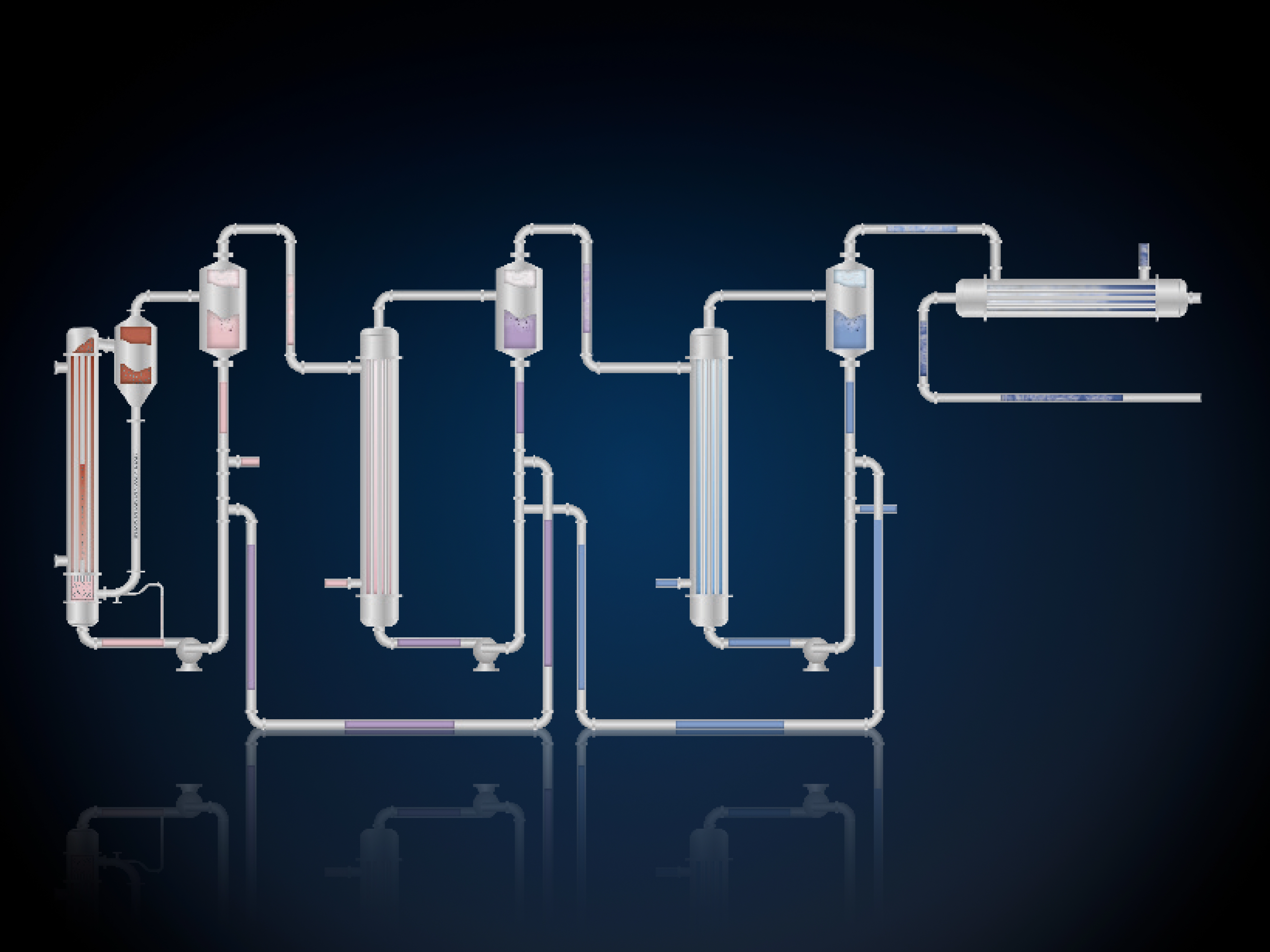
When multi-effect evaporators (MEE) or mechanical vapor recompression (MVR) systems are hampered by fouling and scaling, the fluidized bed cleaning technology used in Klaren heat exchangers and Klaren MEE/MVR systems restores stable heat transfer in critical effects. Self-cleaning evaporators keep heat transfer coefficients high, reduce cleaning-induced interruptions, and lessen the need for antiscalants and cleaning chemicals. Klaren MVR also allows for particularly energy-efficient concentration by reusing the compressed vapor.